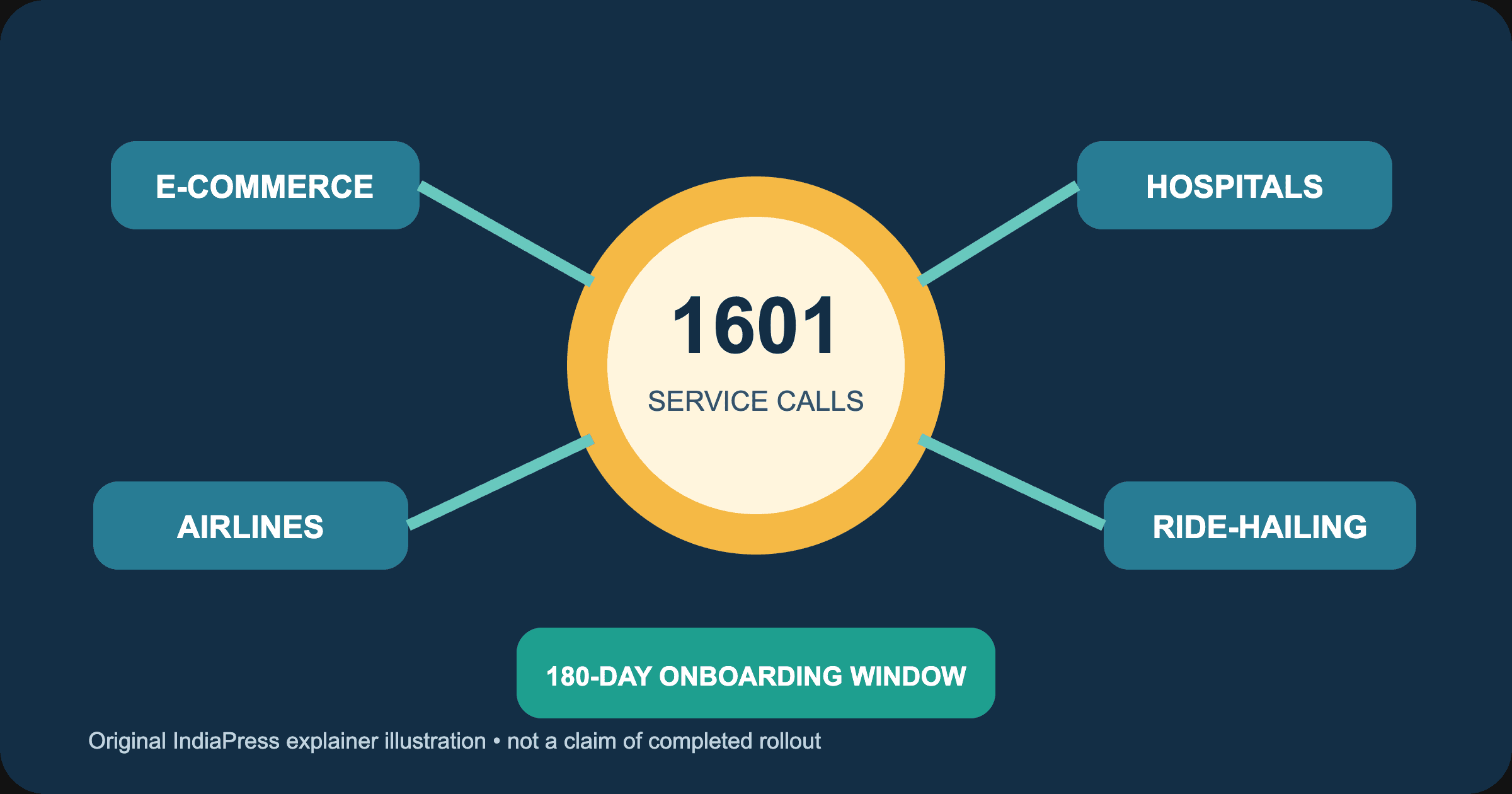
The Telecom Regulatory Authority of India (TRAI) has extended the 1601-series numbering facility to a wider group of consumer-facing businesses, including e-commerce companies, hospitals, airlines, food aggregators and ride-hailing platforms. A direction dated 27 November 2026 allows eligible entities in these sectors to use the series exclusively for service and transactional voice calls. It is intended to help customers distinguish verified business calls from impersonation using ordinary mobile numbers, but the expansion will be phased rather than immediate.
Who can use the series
The eligible sectors named in the second phase include retail chains, e-commerce, hospitals, diagnostic laboratories, telecom service providers, internet service providers, automobile sales and repair businesses, travel agencies, commercial airlines, food aggregators, ride-hailing aggregators and lending service providers. For those businesses, the direction sets a turnover threshold: an entity must have annual turnover of ₹500 crore or more in at least one of the preceding three financial years. The numbers are assigned only to companies registered in India under applicable law.
Distribution platform operators have a separate threshold. DTH, HITS, IPTV and multi-system operators may qualify if they had a subscriber base of at least one million in any month during the previous twelve months. These conditions mean that being in a named industry alone does not make every firm eligible. Smaller businesses should not interpret the announcement as an entitlement to obtain a 1601 number directly.
What customers may notice, and when
TRAI says the 1601 series is designated for service and transactional voice calls, not promotional calls. It describes allocation to verified entities as a way for consumers to identify legitimate service calls and reduce impersonation by fraudsters using normal ten-digit mobile numbers. The first phase had already allowed utilities and logistics and courier services to use the series; the 27 November direction extends the framework to the additional sectors above.
The timeline is important. Access providers must complete onboarding and migration of eligible entities within 180 days from the direction. They must publicise availability to eligible organisations, submit progress reports to TRAI every fifteen days, and file a final compliance report within fifteen days after the 180-day period ends. Accordingly, customers should not assume that every eligible company will switch at once, or that an ordinary number used by a business today is automatically fraudulent.
What the number can and cannot establish
The number series can make it easier to recognise a call intended for a service or transaction, but it is not a universal guarantee about the caller’s request. The direction does not remove the need to check whether a call matches an order, booking or account interaction. Consumers should still refuse requests for OTPs, UPI PINs, passwords, card security codes or remote access, and should verify unexpected payment or account instructions through the organisation’s official app or a contact method they independently select.
For companies, the policy creates a time-bound onboarding task with an eligibility screen. A covered organisation should confirm its turnover or subscriber criterion, its Indian registered entity, and the service-provider process before promising customers that a new caller ID is live. The distinction between transactional service calls and promotions also matters operationally: the series is not an alternative channel for marketing campaigns.
Implications for smaller providers and service partners
The thresholds focus the second phase on larger companies and operators. A small clinic, online seller or repair shop does not qualify merely because customers recognise its brand or because it receives routine service calls. Smaller firms may still depend on a large eligible platform or service provider for customer updates, but the direction does not itself give every subcontractor a separate number allocation. Businesses should confirm the named eligible entity and the access provider’s process before changing customer-facing scripts, invoices or support pages.
The 180-day period also creates a transition rather than a single national cutover date. TRAI has required access providers to make the series available to eligible entities, onboard and migrate them within that period, and send progress reports every fifteen days. These reports are the mechanism to watch for implementation progress; the announcement does not publish a list of companies already migrated. A company’s absence from a 1601 display today therefore should not by itself be treated as evidence that a call is fake.
For customers, the most useful expectation is that a 1601 caller should be tied to a service or transaction, not an unsolicited promotion. If someone claims to represent a retailer, hospital or airline, check the interaction in the official app or through a saved contact route. That habit remains useful during the migration and after it: number recognition can reduce uncertainty, while independent verification protects against pressure tactics and requests for sensitive credentials.
Why this phase matters
The expansion targets sectors whose customers often expect calls about deliveries, health appointments, travel, repairs or account servicing. A recognisable numbering range may give those customers more context before answering, while the eligibility and verification requirements aim to make the designation meaningful. Its practical effect will depend on adoption, public awareness and how consistently organisations keep call purposes within the permitted scope. TRAI says it may add more sectors after reviewing implementation.
The official Ministry of Communications release carrying TRAI’s direction lists the eligible categories, thresholds and reporting schedule. Customers who want a step-by-step way to handle a new or suspicious service call can use our TRAI’s official direction PDF.
The announcement establishes an eligibility and rollout framework; it does not mean the transition is already complete or make caller ID proof of every request.